
Building New Zealand's Energy Infrastructure on Solid Ground
Updated: Jul 24

New Zealand's electricity demand is forecast to rise by around 80% by 2050, according to MBIE’s latest review. New Zealand needs more energy infrastructure: more renewable generation, stronger transmission, and networks that can keep performing through earthquakes, floods, landslides and extreme weather.
That puts pressure on developers, asset owners and designers to build quickly, but reliably. On projects like wind farms, solar farms, substations, dams and transmission corridors, one of the biggest risks sits beneath the site: the soil, rock, groundwater and natural hazards that control foundations, earthworks, access, earthing and long-term resilience.
Treating ground investigation as a box to tick is usually a false economy. Find a problem late, and it becomes a redesign, a construction delay, an overbuilt foundation or an earthing system that does not perform as intended. Understand the ground early, and the design can be based on measured evidence rather than assumptions.
That is where geotechnical engineering and geophysics add value to energy projects.
Different Generation Types, Different Ground Challenges
Energy projects vary enormously, but they all depend on the ground beneath them. Soil, rock, groundwater and natural hazards influence what can be built, how foundations are designed, how much earthworks are needed, and what the project will cost.
Wind Energy
Wind farms are often built on ridgelines and exposed terrain, where rock depth and ground conditions can change significantly between turbine locations. Turbine foundations carry large dynamic and cyclic loads, so design needs to reflect the conditions at each position, not an average across the site.
Access roads and crane hardstands also create earthworks challenges on steep or remote ground. Mapping conditions across the site first, then targeting boreholes and testing, can be more effective than relying on blanket intrusive investigation.
Solar Energy
Utility-scale solar farms cover large areas, often on flat-to-rolling land. Their foundations, typically driven piles or ground screws, are shallow but numerous, with thousands of supports spread across the site.

That makes site-wide ground variability the key issue. Soft spots, shallow rock, expansive soils or changing conditions can affect pile driveability, holding capacity and construction cost. A few boreholes may not capture that variability, so geophysical survey and site characterisation can add real value.
At a recently constructed 20 MW solar farm near Maungaturoto, moderately sloping land, very soft expansive clay near the surface and natural hazards all had to be considered in the foundation design.
Hydro Energy
Hydro projects, including dams, spillways, canals and intakes, depend heavily on the ground and rock they are built on. Slope stability, seepage, rock quality and the behaviour of ground around water-retaining structures are central to design and long-term safety.
These projects often need detailed geotechnical investigation and geophysical survey, particularly where assets are large, ageing, difficult to access or sensitive to disturbance.
Geothermal Energy
Geothermal developments can involve difficult terrain, altered or weak ground, elevated temperatures and aggressive ground conditions. These factors can affect both the ground and the infrastructure built on it.
Because geothermal ground conditions can be highly variable, early subsurface investigation is important for foundations, earthworks, access and long-term performance.
Transmission and substations
Transmission lines cross long corridors where ground conditions can change constantly. Tower foundations need to suit slopes, soft ground, waterways, rock and other constraints along the route.
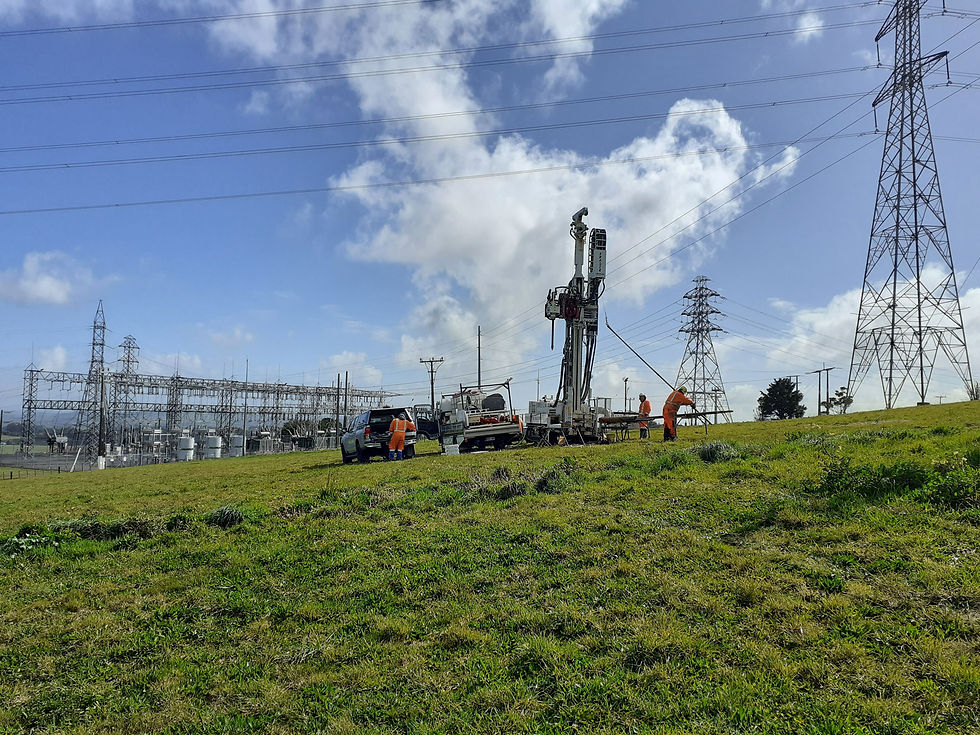
Substations concentrate heavy plant and critical electrical infrastructure on a single site. Foundation conditions matter, but so does the ground’s electrical resistivity, which directly affects substation earthing design. Measuring resistivity accurately is central to designing an earthing system that keeps people and equipment safe. Optimising the use of earthing copper helps to reduce build cost and improves sustainability.
Across all of these project types, the common thread is clear: energy infrastructure is highly sensitive to ground conditions. Because projects are often large, variable or difficult to access, isolated boreholes can leave too much unknown. Understanding the ground early, and across the site, helps each project be designed around measured conditions rather than assumptions.
Where geophysics adds value on energy projects

(Photo: Transpower)
Traditional intrusive investigation, such as boreholes and test pits, gives detailed information at the locations tested. But energy infrastructure is often spread across large or difficult sites: wind farms across ridgelines, solar farms across wide areas, and transmission lines across long corridors. A scatter of boreholes can leave too much unknown between test points.
Geophysics helps fill that gap. Methods such as Electrical Resistivity Tomography, or ERT, and Multichannel Analysis of Surface Waves, or MASW, can map ground conditions across a site non-invasively, helping identify rock depth, weak soils, groundwater, faults and other constraints. The results can then be used to target intrusive testing where it will add the most value.
At Cook Costello, our in-house geophysics team works alongside our geotechnical, civil and structural engineers, so the findings feed directly into foundation design, earthworks planning, access design and risk assessment rather than being handed between separate firms.
One application is especially important for energy infrastructure: substation earthing design. An earthing system safely carries fault current and lightning strikes into the ground, helping keep voltages within safe limits for people and equipment. Its performance depends heavily on the ground’s electrical resistivity, which can vary widely across a site and with depth.
Designing earthing on assumed resistivity values risks either an unsafe system or an over-built, unnecessarily expensive one. ERT and earth-resistivity survey methods measure how resistivity changes across the site, giving electrical designers site-specific values to work with. Design optimisation helps to reduce the build cost and improve sustainability of energy projects.
That means the earthing system can be designed around measured ground conditions rather than textbook assumptions.
Building a Power Network That Withstands New Zealand's Natural Hazards

(Photo: Transpower)
New Zealand asks a lot of its energy infrastructure. Earthquakes, liquefaction, landslides, floods and coastal erosion are recurring risks, and the power network has to keep performing through them.
When a substation is cut off, a transmission tower is affected by slope movement, or a generation site floods, the consequences extend well beyond the asset itself. Communities, businesses and critical services all depend on the power staying on.
Much of that resilience is decided in the ground. A substation on liquefiable soil, a transmission line crossing an unstable slope, or a generation site in a floodplain or coastal hazard area is not just an electrical design issue. It is a ground and natural-hazard issue as well.
Understanding those risks early allows infrastructure to be sited and designed with them in mind: foundations that account for seismic performance, slopes assessed before they move, and sites planned with flood, groundwater and erosion risk understood before construction begins.
Cook Costello has assessed and remediated damage from some of New Zealand’s largest natural-hazard events, including the Canterbury and Kaikōura earthquakes and the 2023 storms. That experience informs how we investigate new infrastructure sites, identify the hazards that matter, and help design energy infrastructure that is better prepared for the conditions it may face over its life.
Why it matters to the people building energy infrastructure
For energy companies and developers, early ground investigation helps protect programme and budget by finding major ground constraints before construction starts.
For electrical, civil and structural engineers, it means foundation design, earthworks, access and substation earthing can be based on measured site conditions rather than assumptions.

For planners, councils and government agencies, evidence-based site investigation supports better decisions about consent, resilience and long-term infrastructure performance.
The value is the same for everyone involved: fewer unknowns, dealt with early while they are still cheaper and easier to manage.
Common Questions About Ground Investigation for Energy Projects
“What ground investigation does an energy project need?”
It depends on the type, scale and risk of the project. Most energy infrastructure needs geotechnical investigation, such as boreholes, CPTs, test pits and laboratory testing. Larger or more variable sites often also benefit from geophysical survey.
The geotechnical work confirms conditions at specific locations. The geophysics helps map how ground conditions change across the wider site. Together, they support foundation design, earthworks, access, slope stability and, where relevant, substation earthing design.

“How does geophysics help wind and solar developments?”
Wind and solar developments are often spread across large or variable sites. A small number of boreholes can leave a lot unknown between test points.
Geophysical methods such as Electrical Resistivity Tomography, or ERT, and Multichannel Analysis of Surface Waves, or MASW, can help identify rock depth, weak ground, groundwater and other constraints across the site. That matters for wind turbine foundations, access roads, crane hardstands, solar pile driveability and ground-screw performance.
“Why does substation earthing design depend on the ground?”
A substation earthing system carries fault current and lightning strikes safely into the ground. Its performance depends heavily on the ground’s electrical resistivity, which is a measure of how readily the soil and rock conduct electricity.
Resistivity can vary widely across a site and with depth. Designing earthing from assumed values can lead to a system that is either under-designed or unnecessarily expensive. Earth-resistivity testing and ERT give electrical designers measured values to work with.
“How does ground investigation help energy infrastructure cope with natural hazards?”
Energy infrastructure in New Zealand needs to account for earthquakes, liquefaction, landslides, flooding, groundwater and coastal hazards.
Ground investigation helps identify those risks early, so substations, transmission towers, wind turbines, solar farms, dams and access roads can be sited and designed with the hazards understood. That is usually far cheaper and safer than discovering the vulnerability after construction, or after a natural-hazard event.
Where we come in

Cook Costello supports energy and infrastructure projects across New Zealand, including substations, solar farms, dams and wind turbine sites.
Our approach brings geophysics, geotechnical, civil and structural engineering together in one team. That means the ground investigation is designed, carried out and interpreted as part of the wider engineering problem, not as a standalone report handed between firms.
For energy projects, that matters. The same investigation may need to inform foundation design, earthworks, access, slope stability, flood exposure, seismic risk and substation earthing. By combining geophysical survey with targeted geotechnical testing, we help build a site-wide ground model that designers and asset owners can use with confidence.
If you are planning an energy or infrastructure project, tell us about the site. We can advise how a combined geophysical and geotechnical investigation could help identify the ground risks early and support a more resilient design.
OR

