
My house is on a slope that’s moving. What are my options?

Noticing ground movement around your home is genuinely unsettling. Cracks may appear in the lawn or driveway, a retaining wall may start to lean, walls may crack after heavy rain, or part of the section may visibly drop.
While ground movement can be concerning, it is relatively common on New Zealand slopes. It exists on a spectrum from minor to serious, and in many cases there are practical options once the cause is understood.
This guide explains what slope movement means, how to gauge urgency, what an assessment involves, and the options that usually follow.
First: is it urgent?
Most slope movement is slow and manageable, but some situations need immediate action. Treat it as urgent if you see rapid change, cracks widening over days rather than months, ground visibly slumping, scarps or steps appearing in the ground, structures leaning noticeably, or new movement during or soon after heavy rain.
If any part of the property feels unsafe, keep people away from it. If you think the house itself may be at risk, contact your council and, if there is immediate danger, emergency services.
If the movement follows a storm or heavy rain event and there is damage, contact your insurer early. Land damage from storms, floods and landslides may involve both your insurer and the Natural Hazards Commission (NHC) Toka Tū Ake, depending on the circumstances and the type of damage.
If the movement is slow, subtle or long-standing, it is still worth understanding, but you usually have time to assess it properly rather than rushing to a solution.

Why slopes move
Slopes move for a reason, and finding that reason is our focus. The visible damage is usually a symptom. Treating the symptom without understanding the cause is how people end up spending money twice.
The most common driver in New Zealand is water. Prolonged or intense rain can raise groundwater levels and saturate soil, reducing its strength. That is why movement often appears in winter or after storms.
Other causes include natural instability in weak or weathered ground, old fill placed on the slope decades ago, excavation that removed support, drainage changes that concentrate water, erosion undercutting the toe of the slope, vegetation removal and earthquake shaking.
Often, more than one factor is involved: water and old fill, a cut slope and poor drainage, or weak ground and erosion.
The signs themselves do not reliably tell you the cause or seriousness. A dramatic-looking crack may be shallow. A subtle one may indicate deeper movement. Anyone diagnosing a moving slope from a photo alone is guessing.
What you can do before an engineer is involved

A few simple steps genuinely help.
Record when you first noticed each sign and whether it is changing. Photograph cracks, scarps, leaning walls and damaged surfaces with something for scale, such as a tape measure or coin. Repeat photos from the same position over time. That is often the cheapest monitoring available.
Check any obvious water sources. Look for overflowing gutters, blocked downpipes, leaking pipes, irrigation discharging onto the slope, or surface water being concentrated where it was not before. Fixing these issues can reduce one of the most common aggravating factors.
Avoid making changes to the slope until it is understood. Do not cut into it, add fill, place heavy loads near the crest, or remove vegetation without advice.
What an assessment involves
A geotechnical assessment of a moving slope works out three things: what is moving, why it is moving, and what can realistically be done about it.
It usually starts with a desktop assessment followed by a site inspection. The engineer will review historical photos, LiDAR, geological and hazard maps and any other available data. They will walkover the site, looking at the pattern of cracks, scarps, deformation, drainage and damage.
Investigation may then be needed to understand the ground and groundwater conditions. Depending on the site, that can include boreholes, test pits, groundwater measurement and laboratory testing. On larger or more complex slopes, geophysical survey may also help. Methods such as electrical resistivity imaging can help identify wet zones, weak layers or potential slip surfaces without digging up the slope.
Where the picture needs time, monitoring may be the right first step. That can range from simple survey marks measured over months to instruments that track ground movement and groundwater. Monitoring helps determine whether the movement is ongoing, seasonal or historic, which can change the recommended response.
The output should be a clear understanding of the likely mechanism and the realistic remedial options.
What the options usually are
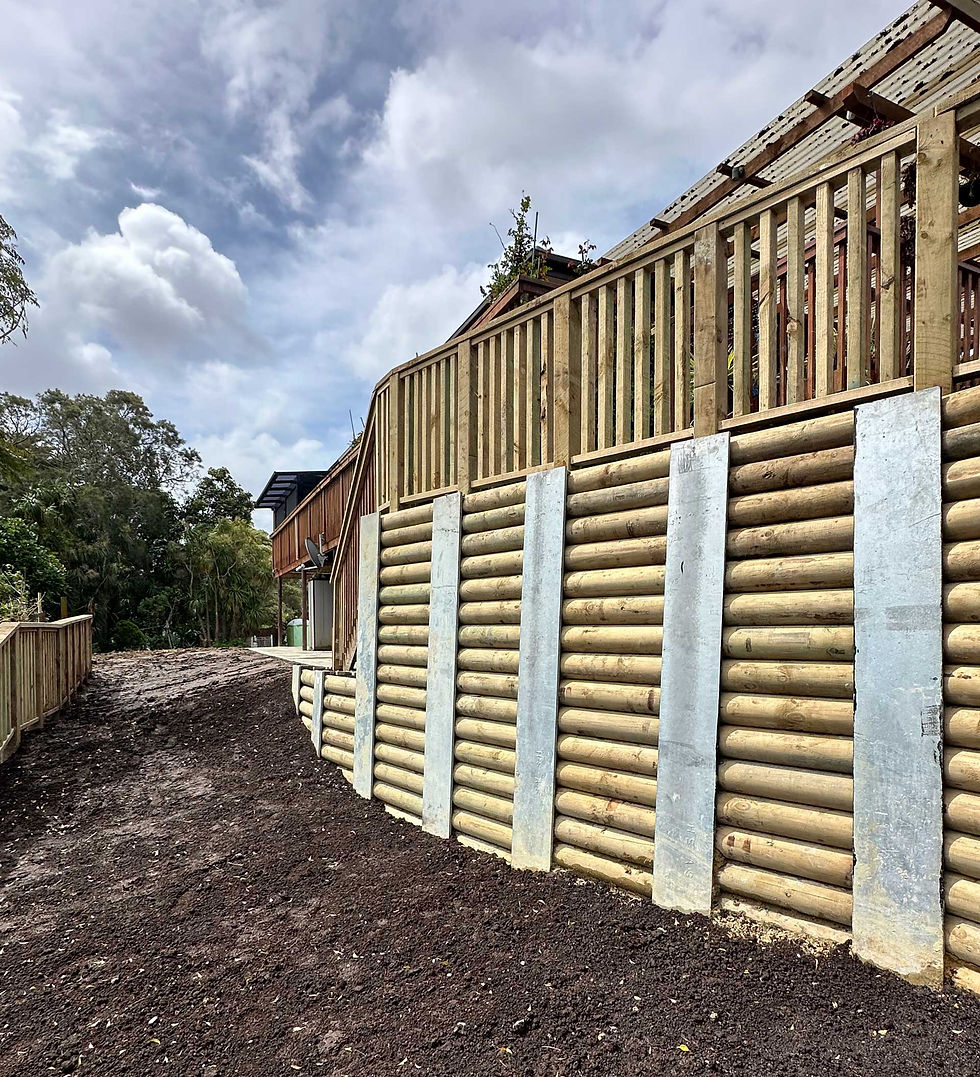
The right response depends on the cause, but most cases fall into a few broad categories.
Sometimes the answer is drainage. Because water drives so much slope movement, controlling it can be the most effective and least expensive intervention. That may involve surface drainage, subsoil drains, fixing leaking services, or cutting off water before it reaches the unstable area.
Where the ground itself needs support, stabilisation may be required. Options can include retaining structures, palisade walls, soil nails, regrading, toe support or erosion protection. The right solution should be sized to the actual mechanism, not a worst-case assumption.
Sometimes the best answer is to monitor first. If movement is slow, seasonal or possibly historic, measuring it before committing to major works can show whether intervention is needed at all. Spending a little on monitoring can avoid spending a lot on unnecessary construction.
In other cases, the movement is shallow or localised, such as old fill settling or shrink-swell movement in clay. The response may be modest repair, drainage improvement and observation rather than major stabilisation.
In a small number of serious cases, the assessment may need to consider the safety and long-term viability of structures on the slope. If that is the situation, it is far better to understand it early, with options, than discover it late.
Where insurance fits

Land damage from storms, landslides and other natural events may be covered, depending on the policy, the event and the type of damage.
In New Zealand, natural-hazard land cover can involve both your private insurer and NHC. NHC provides limited cover for certain residential land, including some land under and around the home, and in some cases certain bridges, culverts and retaining walls.
Your insurer and, where relevant, NHC are the right people for questions about cover. The engineering role is different. A clear assessment explains what moved, why it moved, whether it is still moving, and what repair or remediation is likely to involve. That evidence can become an important part of a land-damage claim.
Where we come in

Cook Costello assesses moving slopes and designs slope remediation across New Zealand. Our experience includes large-scale land and slope damage from events such as the Auckland Anniversary storms and Cyclone Gabrielle, so we have seen how slopes fail and how they can be brought back at different scales.
Because our geotechnical engineers, geophysicists and surveyors work as one team, we can investigate the slope, visualise what may be happening within it, monitor movement where that is the sensible first step, and design remediation matched to the likely mechanism.
Where there is an insurance claim, we can provide clear engineering evidence and work alongside your insurer.
Our approach is to measure before assuming. You should not be sold the maximum intervention if drainage, monitoring or a more targeted repair will do. The aim is the response the slope actually needs.
If your property is on a slope that appears to be moving, or you have noticed early signs, tell us what you are seeing. Photos and a short description are a good start, and we can advise whether an assessment is needed and what it would involve.
OR


